Anderson G. de Oliveira ↗
Chemist · Yeshiva University, USA
 STEVANILAB← Back to team
Principal Investigator · IQ–USP
Associate Professor of Organic and Environmental Chemistry. Researching the chemistry, ecology and applications of fungal bioluminescence.
Cassius V. Stevani’s scientific trajectory began with peroxyoxalate chemiluminescence, where his studies helped clarify reaction kinetics, high energy intermediates and the chemiexcitation step. During his postdoctoral research, seeking a more applied problem that also involved fieldwork, he investigated damage to automotive coatings caused by dragonfly eggs and helped identify cysteic acid as a chemical mediator of polymer degradation.
At the same time, field studies of fireflies led him to investigate how these insects perceive light and use signals to recognize and communicate with members of the same species. His research also examined oxidative stress and the mechanisms that modulate the color of their bioluminescence. During one of these expeditions, he decided to propose a research program on bioluminescent fungi.
His group demonstrated that fungal bioluminescence is an enzymatic process, resolving a controversy that had persisted for more than three decades. The group also developed a method for purifying fungal luciferin, providing an essential step toward its identification and the elucidation of the light emitting mechanism. Subsequent studies showed that fungal light attracts insects that can assist in spore dispersal, identified the fungal luciferin and luciferase, elucidated the complete biochemical mechanism and enabled the development of a genetically encodable bioluminescent system.
Today, his research extends to other bioluminescent systems and environmental metagenomics, connecting fundamental chemistry with biodiversity, ecology, biotechnology and new analytical tools.
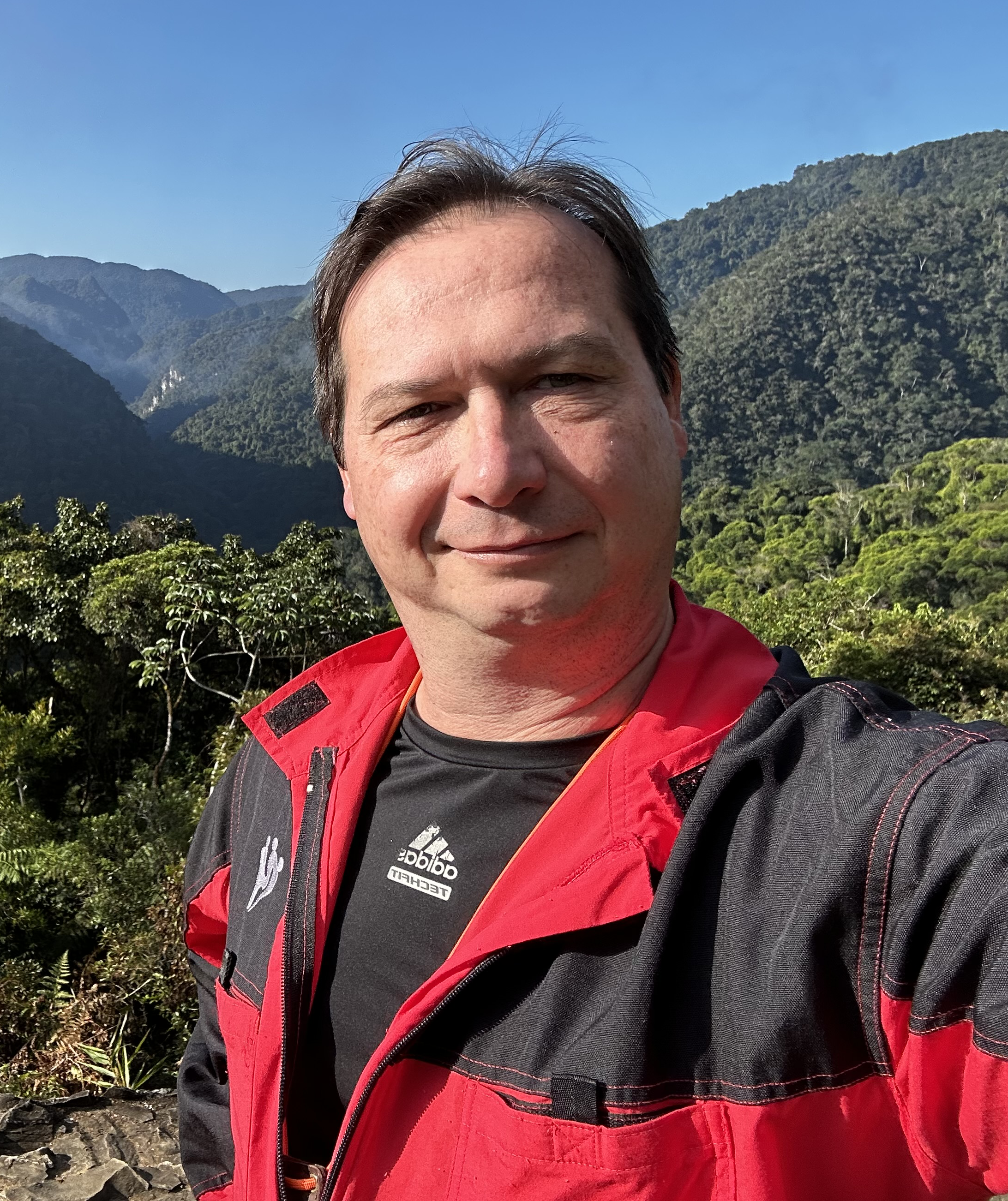
01 / Biography · Biografia
Born in São Paulo in 1971, Cassius V. Stevani graduated in Chemistry from the University of São Paulo in 1992 and received his PhD in Organic Chemistry in 1997 under Josef W. Baader ↗, investigating the mechanism of the peroxyoxalate chemiluminescent system. His postdoctoral research in Biochemistry with Etelvino J. H. Bechara ↗ focused on the degradation of acrylo-melaminic automotive resins by dragonfly eggs and received an ABRAFATI award in 2000. At IQ–USP, his group investigates academic and applied aspects of fungal bioluminescence.
Nascido em São Paulo em 1971, graduou-se em Química pela Universidade de São Paulo em 1992 e concluiu o doutorado em Química Orgânica em 1997, sob orientação de Josef W. Baader ↗, estudando o sistema quimiluminescente peróxi-oxalato. No pós-doutorado em Bioquímica com Etelvino J. H. Bechara ↗, pesquisou a degradação de resinas automotivas acrilo-melamínicas por ovos de libélula, trabalho premiado pela ABRAFATI em 2000. No IQ–USP, seu grupo investiga aspectos fundamentais e aplicados da bioluminescência fúngica.
02 / CV & Research indicators
03 / Collaborators
Longtime collaborators in chemistry, biology, fungal taxonomy, chronobiology and biotechnology.
Chemist · Yeshiva University, USA
Biologist · Cal State East Bay, USA
Biologist · San Francisco State University, USA
UNESP Dracena, Brazil
Chemist · IQ–USP, Brazil
Chemist · IQ–USP, Brazil
Chemist · IBCh RAS, Russia
Biologist · Dartmouth Geisel School of Medicine, USA
Biologist · Dartmouth Geisel School of Medicine, USA
Chemist · IQ–USP, Brazil
Biologist · Imperial College London, UK
Biologist · Helmholtz Pioneer Campus, Germany
Biologist · IFSP, Brazil
Chemist · IQ–USP, Brazil
Chemist · UNIFESP, Brazil
Biologist · Virginia Tech, USA
Chemist · IQ–USP, Brazil
Biologist · UFSCar, Brazil
Biologist · Virginia State University, USA
Biologist · Chubu University, Japan
Institutional partner
IPBioInstituto de Pesquisas da Biodiversidade, Brazil↗